
Run Large Local Models on a Desktop-Sized Machine
The limit on local AI has always been memory, not processors. To run large local models at useful context, you need enough unified memory to hold the weights plus the KV cache, and that number climbs
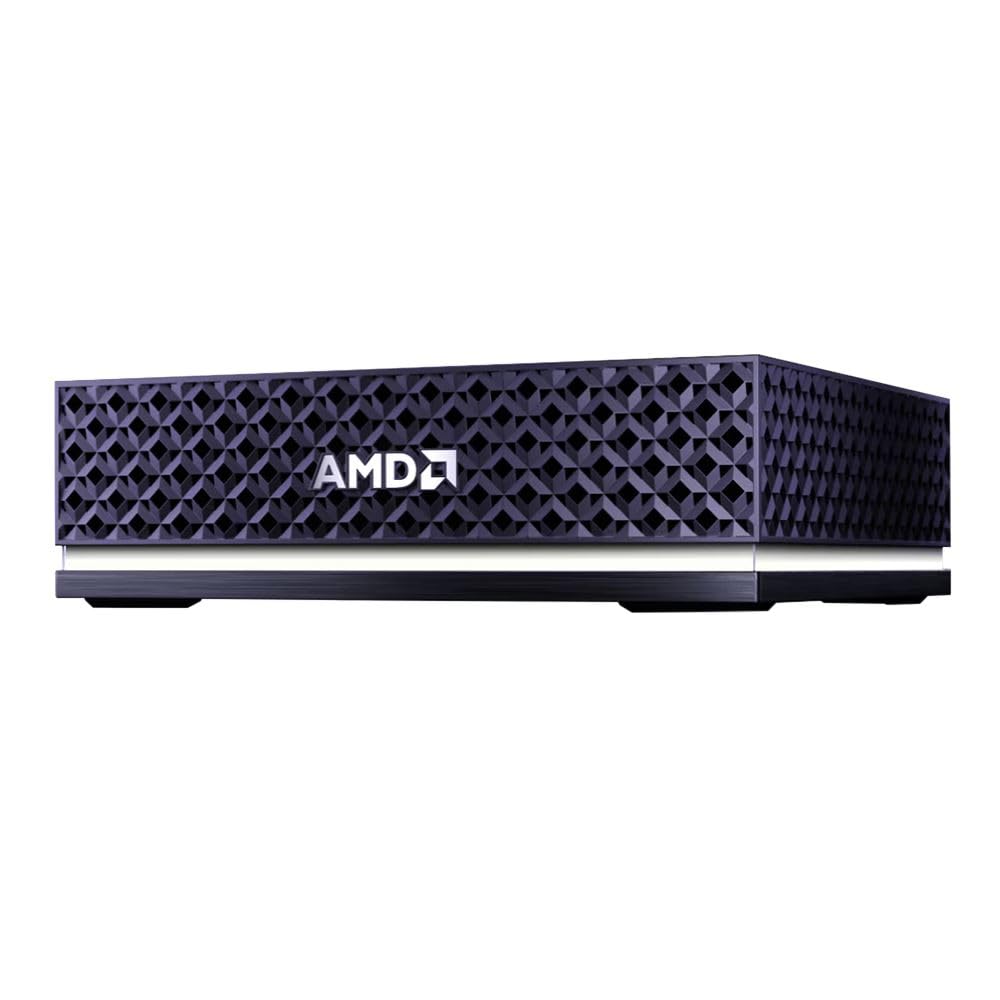
The limit on local AI has always been memory, not processors. To run large local models at useful context, you need enough unified memory to hold the weights plus the KV cache, and that number climbs fast: a 70B model at 4-bit wants roughly 40GB before context, and a 120B-class model wants close to 70GB. That is why 128GB machines changed the conversation. A desktop-sized box built around AMD's Ryzen AI Max+ 395 pairs 128GB of LPDDR5X with a Radeon 8060S that can address a large share of that pool, which is what lets it hold models a 32GB machine cannot touch. The AMD Ryzen AI Halo in this category is the reference build, and its unified memory is the whole point: the GPU and CPU draw from the same pool instead of the GPU being capped at its own VRAM. What changes at this size: 70B-class models become usable for document analysis and long-form drafting, and 120B-class models at 4-bit become possible with careful context. What does not change: a 128GB local machine is still not a cluster, and the largest frontier models remain out of reach. For anyone who wants to run large local models without a rack, the decision is memory first, then thermals, then storage. The Ryzen AI Halo page in this category covers the 128GB local AI configuration and what it realistically runs.
AMD Ryzen AI Halo (Ryzen AI Max+ 395, 128GB LPDDR5X / 2TB, Linux)
If you want to run large local models at home without building a tower with multiple graphics cards, this AMD machine is designed around that single goal. At its center is the Ryzen AI Max+ 395, a 16-core, 32-thread Zen 5 processor that boosts to 5.1GHz with 64MB of L3 cache, paired with the Radeon 8060S graphics engine carrying 40 RDNA 3.5 compute units and a 50-TOPS XDNA 2 neural processor for roughly 126 combined TOPS across CPU, GPU, and NPU. The headline is memory, with 128GB of LPDDR5X-8000 unified memory running at 256GB per second, where a large portion can be set aside as graphics memory so weights, context, and working data share one fast pool. That arrangement holds 70B-class models in place and reaches toward larger models in the 200B-parameter range in device memory, while the NPU handles background features that would otherwise compete with generation. Storage is a 2TB self-encrypting NVMe drive for the system plus a model library, and the footprint is compact at 150 by 150 by 45.4mm and under 1.2kg. Connections cover one 10-gigabit Ethernet port, Wi-Fi 7, Bluetooth 5.4, three USB-C ports plus a dedicated USB-C power input on a single 120W cable, and HDMI 2.1b for a display. It ships on AMD's Linux AI developer setup with ROCm in place, alongside tools such as Ollama, llama.cpp, and vLLM, which suits batch transcription, OCR runs, document retrieval with RAG, vision pipelines, and multi-user local serving for a small team or home lab. It sits at the top of the compact local-AI ladder in this catalog, above the Beelink GTR9 Pro tier, with a one-year limited warranty and third-party marketplace supply, so confirm the live listing before ordering.
- Chip tier
- Strix Halo (Max+ 395)
- Memory
- 128GB LPDDR5X-8000 unified (UMA, soldered — a ceiling; up to ~96GB allocatable as VRAM for
- TOPS
- 50
- Storage
- 2TB M.2 NVMe SSD (SED) pre-installed