amd
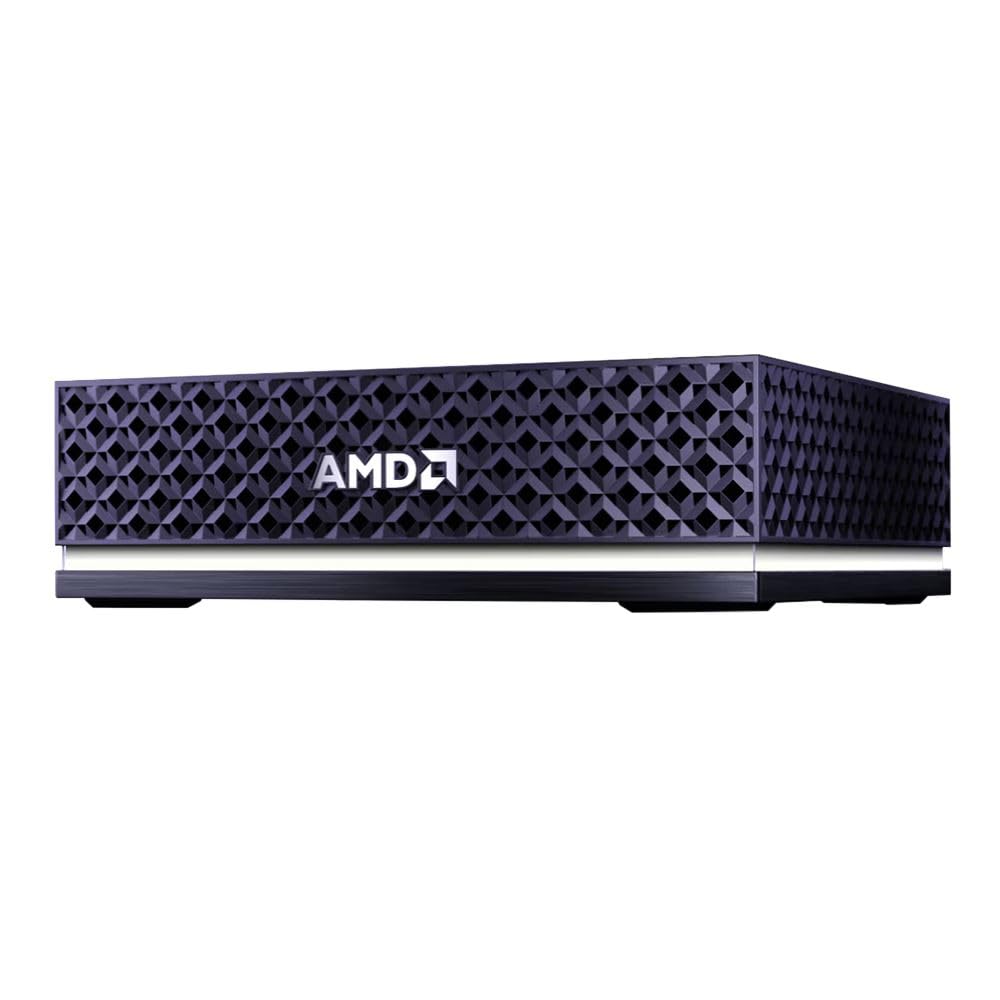
AMD Ryzen AI Halo (Ryzen AI Max+ 395, 128GB LPDDR5X / 2TB, Linux)
If you want to run large local models at home without building a tower with multiple graphics cards, this AMD machine is designed
128GB50 TOPSStrix Halo (Max+ 395)

Why people put a 27B model on their own hardware
There is a quiet assumption built into the standard advice about local AI, which is that the point of running a model on your own hardware is speed. It is not, or at least it is not the interesting point. The real reason people are moving frontier-class models onto their own machines is a set of concerns that have nothing to do with tokens per second: the data you send to a cloud never comes back in a form you control, the service you rely on is a contract someone else holds, and the model that is available this quarter is not guaranteed to be there, or to be the same, next quarter. A local model, in a sense that most people do not fully appreciate, is the only AI that is actually yours.
Start with the data argument, because it is the one that bites hardest for anyone dealing with real information. Every time you query a hosted model, you hand a third party the contents of your question. For a chat with a personal assistant that is mostly trivia, that is an acceptable trade. For a lawyer drafting from a client file, a therapist's notes, a financial model, an internal strategy memo, or a photograph of a patient or a product that has not shipped, the trade is not acceptable, regardless of the provider's privacy policy. A privacy policy is a promise; a model running on your machine is an architecture. When the model is local, the confidentiality stop being a contractual clause and become a physical fact, the data simply does not leave the room, and there is no log on a foreign server to subpoena, to leak, or to use in a way the fine print you agreed to never fully read.
Then there is the subscription argument, which is about dependency in a different direction. A hosted model is a relationship with a single vendor. That vendor can change its pricing, raise it substantially, cap your usage, change the model you had access to, or discontinue the access entirely, and every one of those is a business decision it is fully entitled to make at any time. You have built your tools and your habits on top of services someone else controls, and the relationship can be re-priced or re-shaped without your consent. A model you have hosted yourself is not available in that sense. Your access to your intelligence does not change when a boardroom in another building decides something you did not agree to. The model sits on a shelf you own, loads when you want it, and the only person who can make it unavailable is the one who can unplug the machine, which is you.
Third, the ban and prohibition question, which deserves more serious treatment than it usually gets. Governments and regulators are actively considering rules for the deployment and access of large models. The exact shape of future regulation is unknown, and it would be reckless to predict with confidence. But a local model that you run on hardware you own is categorically more resilient to that uncertainty than a hosted one. The most likely form of any restriction is on access to the most powerful proprietary services and on the collection of user data by their providers, not on a person running an open-weights model on their own machine at their own scale. If the regulatory environment tightens around cloud services the way it has in other parts of the economy, the people who are still running local models will be in a fundamentally better position than the ones who were renting. A local model is not just a technology choice, it is a hedge against a risk that is plausible enough to respect.
The honest counterweight: a local model does not replace a frontier hosted model on every dimension, and anyone who pretends otherwise is selling something you do not need. The very largest proprietary systems are still the most capable in absolute terms, and a local twenty-seven-class model is not going to match them on the hardest reasoning tasks. The practical answer is that most of what people actually do with AI, drafting, summarizing, organizing, extracting, building, automating, agent-driven work, does not live at the absolute frontier. The models that have been released in open weights form, in the twenty-billion to thirty-billion class, are excellent at the bulk of real work, and the gap matters mainly at the extreme top end. If your use case sits in that top few percent the local model will show its limits, and you should know that in advance. For everyone else, the capability is more than adequate, and the fact that the data, the availability, and the access to the model all belong to you is something you get on top.
Add to this the availability and resilience argument, which is easy to overlook until it matters. A hosted model goes down whenever the provider's infrastructure does, which happens, and it also goes down the moment your network does, which happens more, and you are on the other side of a wall whenever that same network is the one doing the blocking or throttling. A local model is available whenever the machine is on. It is available in a power outage if you have a battery, in an airplane if you are offline, in a meeting room with a bad connection, and in a jurisdiction where the service you used to rely on has chosen not to operate. That kind of availability, the machine does not depend on a third party's network, a provider's status page, or a government's position on the service, is not a small thing for a business or a professional who has built real dependencies into their work.
So the case for local AI is not, as it is often framed, 'own your data instead of renting it.' It is that you own three distinct things at once: the data, because it never leaves your machine; the relationship, because a vendor cannot re-price or withdraw access to a model that is sitting in your cabinet; and the capability itself, because the model is an asset on your shelf that works the moment it is loaded, no matter what is happening in the rest of the world. For privacy, the relationship is a physical fact instead of a contract clause. For economics, it removes a line item from the recurring and unpredictable. For resilience, it decouples availability from the network and from a provider's decision. For independence, it gives you something no one else can take away, the right to run the intelligence you rely on, on terms you set. That is what a local model is for, and it is why increasingly, the people who build systems that need to last are building on their own hardware.
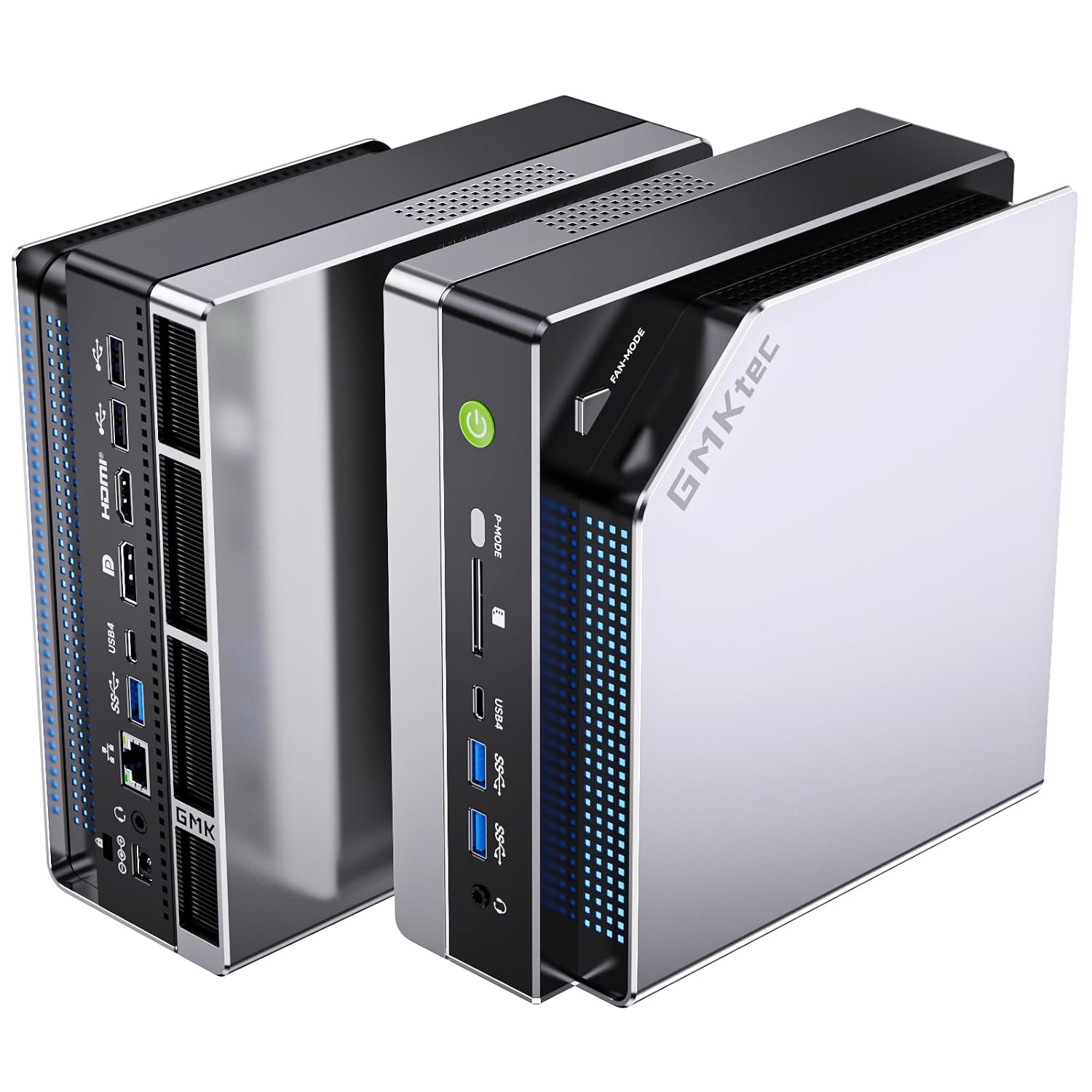
This GMKTec desktop is the compact end of the Strix Halo class, for people who want the largest models that will fit in a desk-sized machine. The Ryzen AI Max+ 395 provides sixteen Zen 5 cores and thirty-two threads to 5.1GHz with 64MB of L3 cache, the Radeon 8060S adds 40 RDNA 3.5 cores, and a 50-TOPS XDNA 2 neural processor brings combined output to 126 TOPS. Memory is the reason to buy it, with 128GB of LPDDR5X-8000 soldered on board and up to 96GB assignable as graphics memory through AMD software, so weights and context share one pool without the VRAM wall that caps most compact desktops. That supports 30B through 70B quantized models, on-device image generation alongside a chat session, document retrieval, batch OCR, transcription, and vision pipelines, and the vendor cites even larger models at reduced precision within the same pool. Storage starts at 2TB of PCIe 4.0 NVMe with a second M.2 slot taking expansion to 8TB for a full library. Ports include dual USB4 at 40 gigabits per second, three USB 3.2 Gen2 ports, two USB 2.0 ports, HDMI 2.1 to 8K and 60Hz, DisplayPort 1.4, Wi-Fi 7, Bluetooth 5.4, an SD 4.0 reader, and a single 2.5-gigabit Ethernet port supplied through an external power pack. A triple-heat-pipe stack with dual CPU fans plus a DDR and SSD fan keeps the sealed tool-less chassis steady under sustained load. Plan a single large model resident at a time so context and weights fit comfortably together in the shared pool. The memory is a fixed ceiling that cannot be expanded, some listings mislabel the graphics engine while the spec table identifies the Radeon 8060S, and the single wired port trades against workstation-class alternatives with more expansion.
If you want to run large local models at home without building a tower with multiple graphics cards, this AMD machine is designed
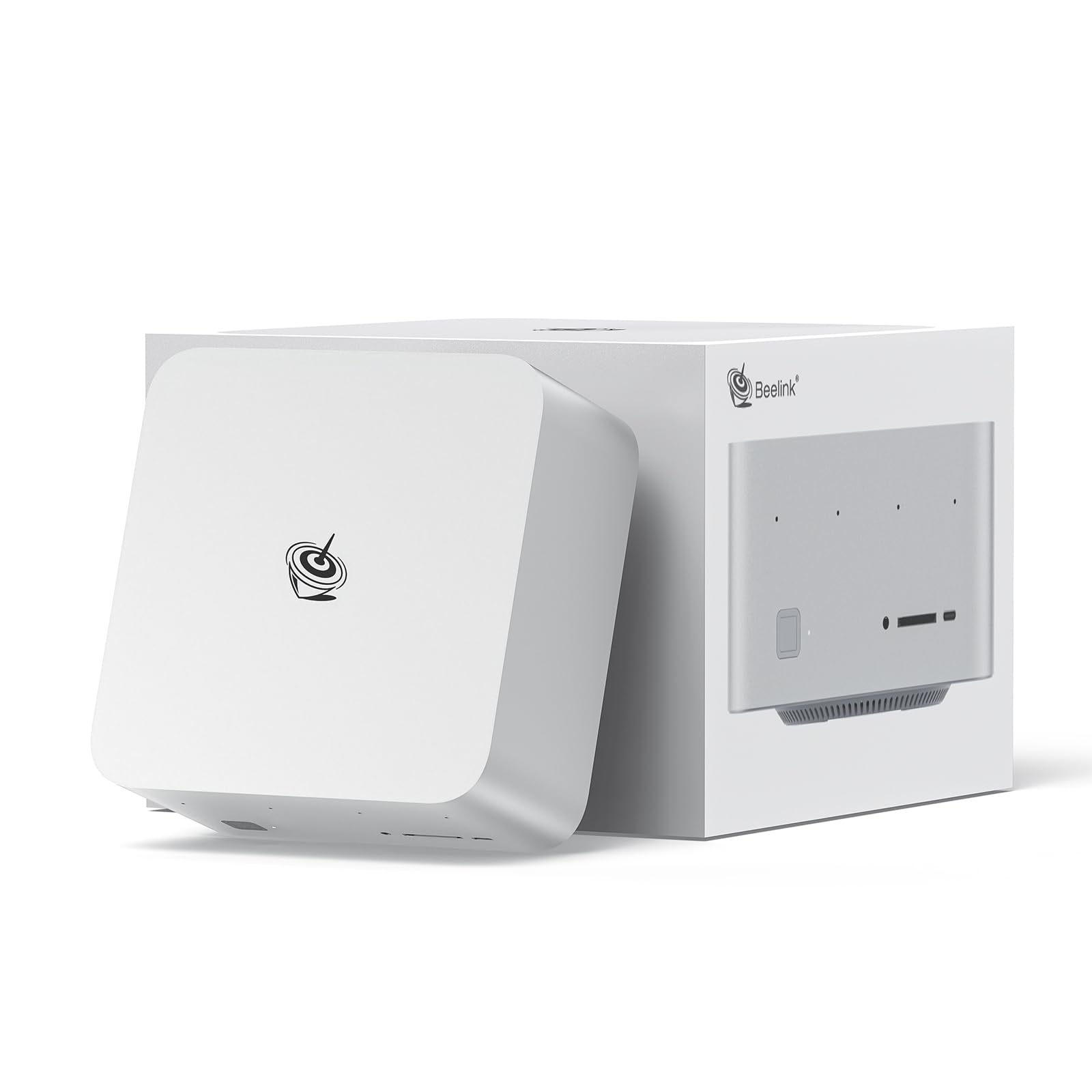
This Beelink desktop targets home labs and small teams that want 70B-class local inference in a compact chassis without assembling
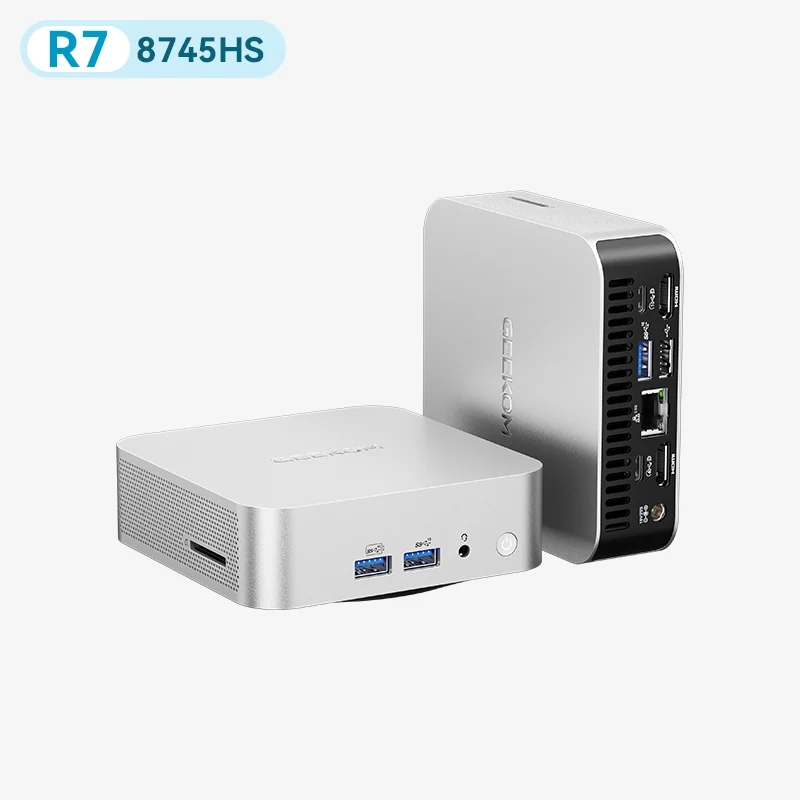
This GEEKOM mini PC is positioned as a general workstation for people whose day involves code builds, design files, 4K exports, an