The per-token cost, and why it is an AMD argument
There is a number that the AI hardware world rarely shows you, and it is the one that decides who gets to say affordable: the cost of a single token of inference. Everything else, FLOPS, VRAM, brand, benchmark, is a proxy for that number, and most of the proxies are worse than they look, which is why the default assumption that NVIDIA is the only sensible answer for local AI survives even though the arithmetic says otherwise. This article is about that number, and it is an argument, in dollars, for AMD.
Start by defining the denominator. The cost of a token is not the price of the card you buy, it is the total cost of ownership of the machine that generates it, divided by the number of tokens it produces over its working life. The ownership cost has three parts: the purchase price, the electricity it burns while running, and the depreciation, which you can approximate as the purchase price amortized over a realistic life. All three of those numbers are dramatically different for an AMD APU system and a discrete card build, which is the entire reason the per-token cost is a different question from the per-card price.
The purchase price is where the advantage is widest and most obvious. A system with an RDNA 3 integrated core and sixty-four gigabytes of memory, the configuration that hosts a 27B model with room, lands at a price that is a fraction of what a comparable discrete-card machine costs for the same model capacity. The discrete card alone, at the VRAM pool needed to host the same 27B model comfortably, is a large chunk of the total system price, and the rest of the system, the chassis, the power supply sized to feed it, the cooling, the motherboard, is all you have to buy on top of the card. The integrated system has all of that built into the one price, and the price is lower, because there is no separate accelerator to buy and no oversized power supply to feed it.
The electricity term is where the discrete build quietly loses a second way, and it is the term most people ignore. A discrete card under load draws a hundred and fifty to three hundred watts, and the system around it draws more on top. An APU system under full AI load draws a fraction of that, and at idle it is in the tens of watts, and it is not unusual for that machine to be idle most of the day while the model is loaded and ready. Over the life of a machine that runs a model for hours at a time, the electricity difference between the two is not a rounding error, it is a real and recurring amount, and it all goes straight into the token cost. The more continuously the machine runs, the more the electricity term matters, which is exactly the agent and always-on case, and in that case the gap is widest.
The numerator, the tokens produced, is where the argument is most technically honest and where the FLOPS myth dies. Two machines that both host the same 27B model at the same quantization do not produce tokens at a rate set by their FLOPS. They produce them at a rate set by the memory bandwidth that feeds the weights, and at the class of model we are discussing the integrated core, which is not the most FLOPS-dense thing in the room, is not the bottleneck. The weights flow at a rate the bus can feed them, and the core consumes them as fast as they arrive. That is the property that makes the per-token cost an AMD argument, because the AMD configuration produces tokens at a speed that is close enough to a much more expensive discrete build to make the price difference dominate the total. You do not need the faster core, you need the memory to hold the model and the bus to feed it, and both of those are exactly what the APU system offers at its lower price.
Put it all on one line and it becomes arithmetic. Take the APU system: a lower purchase price, a lower power draw, a comparable token rate for the model, and a depreciation of a smaller asset. Take the discrete build: a higher purchase price, a much higher power draw, a token rate that is better by a margin that does not compensate the price gap, and a depreciation of a larger and faster-depreciating asset. The per-token cost of the APU system is lower, and the margin by which it is lower is a large fraction of the price difference, because the power term compounds over the life of the machine and the price term is front-loaded into the first token. This is the entire case, and it does not depend on a specific model or a specific brand, it depends on the shape of the work: a single stream of inference of a model in the 27B class, on hardware that will be used continuously, at a price that is set by the memory you choose rather than the accelerator you are forced to buy.
The place where the arithmetic flips is worth stating plainly so the argument is honest. If the workload is training, or fine-tuning a large model, or concurrent serving of many users, the work becomes compute-bound and the discrete accelerator, with its higher FLOPS and its larger fixed memory pool, is the right tool and the per-token framing stops applying, because you are no longer doing single-stream inference. If the model is much larger than the 27B class, the memory ceiling starts to bite in a different way and the question becomes a server question. In between, which is exactly the space of local, single-user, 27B-class inference, the APU system is not just a defensible choice, it is the economically correct one, and the per-token cost is the number that proves it. That is the AMD argument in one line: it is not the fastest card, it is the cheapest way to get the tokens you actually need.
Machines for this topic
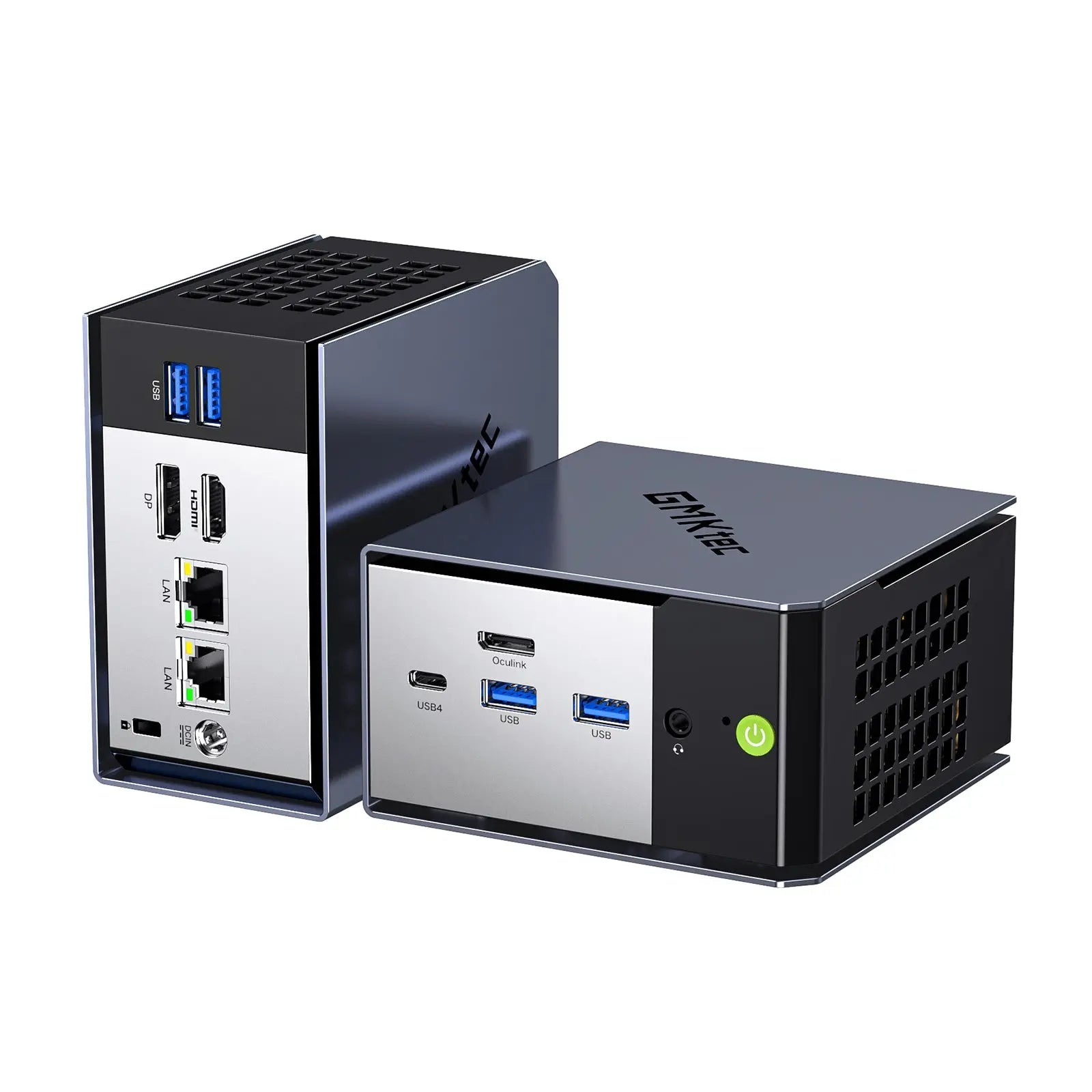
This GMKTec desktop is built to be set up once and left running, for people who want local AI available every day without ongoing hardware projects. The Ryzen AI 9 HX 470 provides twelve Zen 5 cores to 5.2GHz, the Radeon 890M handles quantized inference, and a 55-TOPS XDNA 2 neural processor offloads small always-on tasks so the main engines stay free for models. Memory is 64GB of LPDDR5 at 6400MT/s soldered on the board in a chassis of roughly 0.6 to 0.7 liters, which gives 14B through 27B inference comfortable headroom, including a quantized 27B model with a long context that would push a 32GB box into swap. Because the memory is soldered, there is no later upgrade, and GMKTec is selling a finished appliance rather than a platform to build, which suits a household or workgroup that prefers stability over tinkering. The OCuLink port over PCIe 4.0 x4 remains the long-term escape hatch, since a discrete card can upgrade graphics without replacing the machine. Storage runs across two M.2 slots to 16TB for weights, datasets, and media, while USB4 at 40 gigabits per second, triple 8K display output, dual 2.5-gigabit Ethernet, Wi-Fi 7, and Bluetooth 5.4 cover desktop and server duties. Dual wired ports keep an agent service or inference queue connected, preinstalled tooling lowers the friction of loading a first model, and the neural chip handles background sensing. Keep the system and library on separate drives so a full volume never stalls the desktop, and place the machine where airflow stays clear during overnight inference runs. Buyers planning for 96GB or 128GB in a few years should choose a socketed platform instead, and budget-minded buyers can start one step down with the EVO-X1.