amd
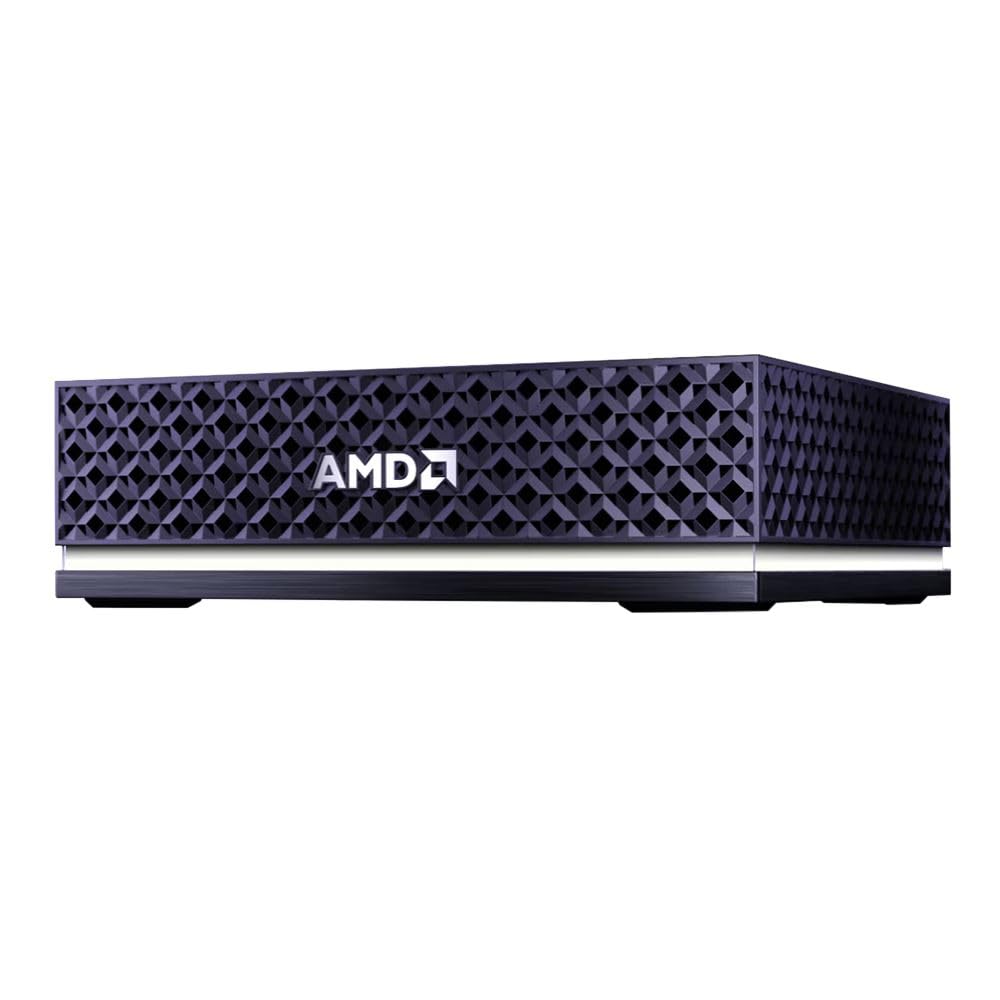
AMD Ryzen AI Halo (Ryzen AI Max+ 395, 128GB LPDDR5X / 2TB, Linux)
If you want to run large local models at home without building a tower with multiple graphics cards, this AMD machine is designed
128GB50 TOPSStrix Halo (Max+ 395)

The technical case for the RDNA 3 iGPU at the 27B class
In the AI world, there is a rule that has been repeated so many times it has become a kind of dogma: integrated graphics cannot do AI, and if you want to run a model you need a serious discrete graphics card. The rule sounds plausible, and for much of the history of GPUs it was approximately true. It is also increasingly wrong, and the specific reason is that AMD has shipped a generation of integrated graphics cores that treat this exact task as their home turf. This article explains why the misconception still exists, why it fails on the technical details, and why an RDNA 3 integrated GPU in a modern AMD APU is, for a 27B-class local AI model, not a compromise but arguably the right answer.
The first thing the dogma gets backward is what the work actually is. Inference on a large language model is not a graphics problem in the way rendering a game scene is. Games demand raw compute throughput and high fill rates, and that is where a discrete card's power and large memory pool have an obvious advantage. A language model running inference is doing something much more like linear algebra at a scale: multiplying and adding matrices over and over, and the bottleneck is not how many operations the card can fire per second but how fast data can move between memory and compute. The model's weights, in a 27B parameter system, are many gigabytes and they need to be in fast, nearby memory. The integrated GPU lives on the same silicon die as the CPU and the memory controller, and it reads from the same memory pool with a latency and bandwidth profile that is materially different from a card on the PCIe bus, in a way that matters precisely for this workload.
The second thing the dogma misunderstands is the memory situation. A discrete graphics card has its own memory, its VRAM, and the amount of it is the hard ceiling on what model can be loaded. A 16 GB card is, in practice, a hard limit on the class of model you can host, and a 24 GB card opens the door to the 27B class but with little room. The integrated GPU does not have its own memory in a meaningful sense, it uses the system memory as a shared pool. That means the ceiling on model size is not a discrete VRAM number but the amount of system memory you put in the machine, which in an APU mini-PC can be configured up to and beyond 64 GB without an order of magnitude price jump. A model that would need a high-end 32 GB discrete card to fit comfortably in VRAM fits in a 64 GB APU configuration on the integrated core at a fraction of the system price, and the bandwidth is not a limiting factor at the class of model we are talking about.
The third thing, and this is the one most people do not think about, is the latency and locality of the memory access. Because the integrated core and the memory are on the same package, the round-trip to memory is short. The data does not leave the die. For a workload where the bottleneck is memory access and the working set is exactly the weights, this is a structural advantage that a discrete card, no matter how much it can spend, cannot replicate. You cannot move the memory any closer than the die. The consequence is that at the 7B to 27B class, which is exactly the class where local inference is economically reasonable, the integrated core is competitive or better on a per-dollar basis, and on a per-system basis it is substantially better because the whole machine is cheaper and quieter and smaller.
So why does the dogma still hold? Three reasons. The first is history: for most of the last decade, the integrated cores were genuinely weak by the standards of a discrete card, and the reputation carried over. The second is the marketing frame, which treats graphics performance as gaming performance, and a core that does not win a game benchmark looks like it cannot do anything. The third is the absence of a single canonical test, so the rule is inherited rather than measured. What the actual measurements show, and this is what the enthusiast and home-AI communities have been documenting for a year or more, is that the RDNA 3 core in the current AMD APUs, the 780M and its successors, is a first-class inference engine at the class of model we care about. It is not a replacement for a high-end discrete card on every possible workload. It is, specifically, the right tool for local inference on a 27B-class model if you are buying a compact system, and that is what this market is actually for.
The honest place the dogma still has force is at two ends of the spectrum. On the low end, below about 3B parameters, the difference between an integrated core and a mediocre discrete card is not large and the integrated core is the obvious and cheaper choice, the dogma is wrong but harmlessly so. On the high end, if you want to run 70B parameters or larger, or if you want to do meaningful fine-tuning or multi-user concurrent serving, the integrated core hits a wall that you cannot overcome by adding memory, and you are in the territory of a serious discrete accelerator or a server. Between those two ends, which is exactly where the 27B model sits, the integrated GPU is the correct default. That is the honest boundary of the dogma, and it is narrower than the rule implies.
This is also why the affordable AMD APU mini-PC has become, quietly, the default local AI machine for people who are not datacenter engineers. A machine with a current RDNA 3 integrated core and 64 GB of memory is a box that will run a 27B model at a quantization point that is actually useful, that will draw tens of watts at idle and under a hundred under load, that will fit on a desk, and that will not cost six figures. That combination, local memory that is not a ceiling, a core that is on the die with that memory, and a price that makes it a plausible daily driver, is the argument no other class of silicon offers in the same package. The dogma that 'integrated graphics cannot do AI' was a fair description of the market two generations ago. It is no longer a fair description of this one, and the 27B model running on an 805M-family core at a reasonable power draw is the specific, measurable proof. The rule is not that you cannot do local AI on an integrated GPU. The rule is that you can, that it is often the right answer, and that the specific architecture AMD has shipped this generation is built for exactly this workload.
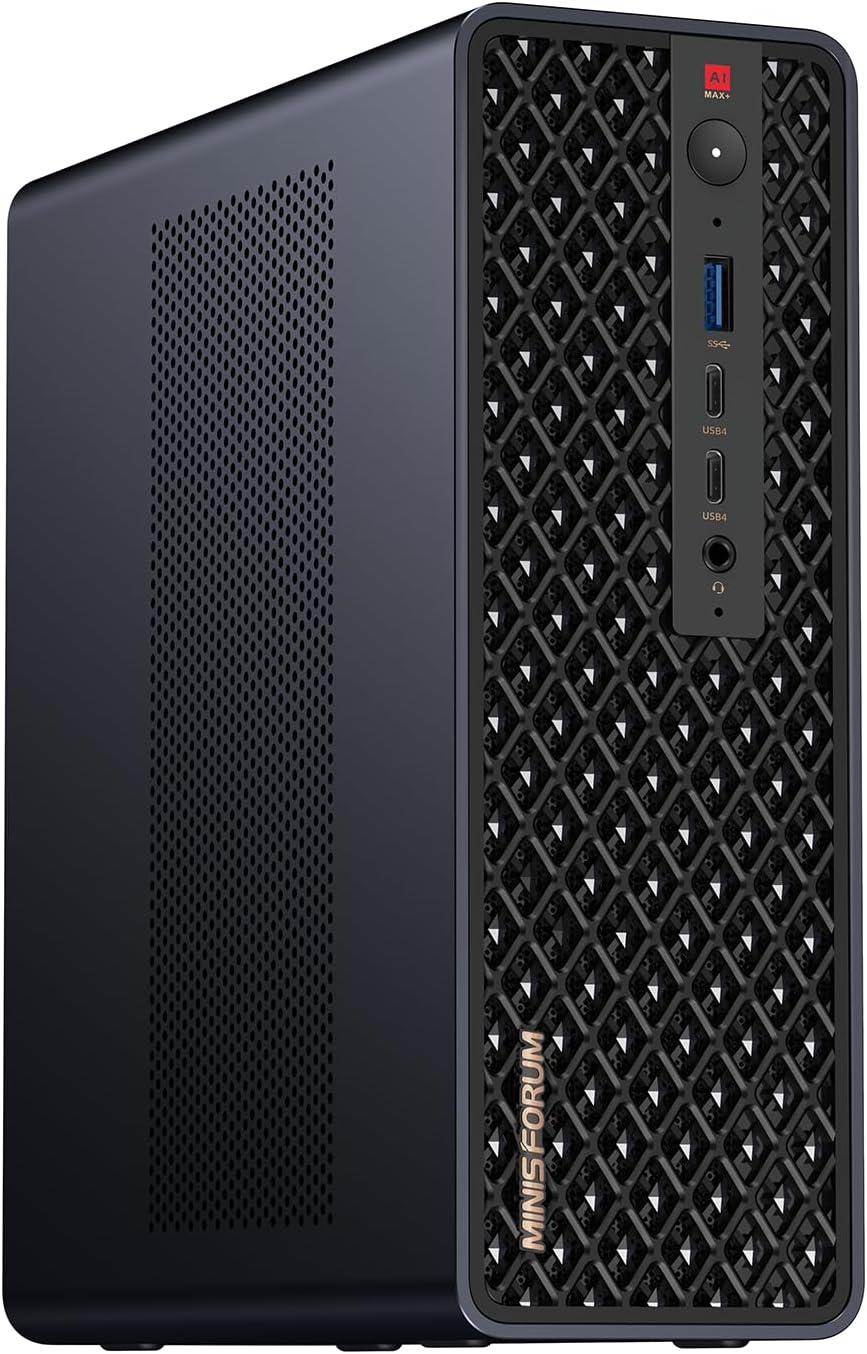
This MINISFORUM workstation is built for buyers who have outgrown the mini-PC tier, in a larger rackable chassis with a built-in 320W supply and slide-out tool-less access near 3.8 liters. The Ryzen AI Max+ 395 provides sixteen Zen 5 cores and thirty-two threads to 5.1GHz with 64MB of L3 cache, the Radeon 8060S handles inference, and a 50-TOPS neural processor brings combined output to 126 TOPS. The 128GB of LPDDR5X-8000 unified memory is shared between CPU and graphics with up to 96GB assignable so 30B to 70B models run at working context, image generation runs on device, and larger models can be served across clustered units for multi-model or retrieval workloads. That removes the VRAM wall that caps many discrete-card boxes at far smaller figures, which matters for private inference, batch OCR, transcription, and vision pipelines without a cloud round trip. Storage is dual M.2 2280 PCIe 4.0 x4 to 16TB in RAID 0 or 1 with 2TB pre-installed, and dual 10-gigabit Ethernet supports NAS, firewall, and link-aggregation roles beyond the 2.5-gigabit standard in smaller boxes. USB4 V2 at 80 gigabits per second plus two 40-gigabit USB4 ports, HDMI 2.1 to 8K and 60Hz, a full-length PCIe x16 slot, Wi-Fi 7, Bluetooth 5.4, and dual noise-cancelling microphones round out workstation input and output. Four switchable modes across performance, balanced, silent, and rack settings plus a reserved cluster power-on interface make it a 2U rack deployment option. The 130W sustained draw means higher power and heat than the mini-PC tier and the memory is fixed at purchase, so allow airflow and confirm the live listing before ordering. For shared rooms, keep the machine in a rack or cabinet where the 320W supply has clear ventilation during long runs.
If you want to run large local models at home without building a tower with multiple graphics cards, this AMD machine is designed
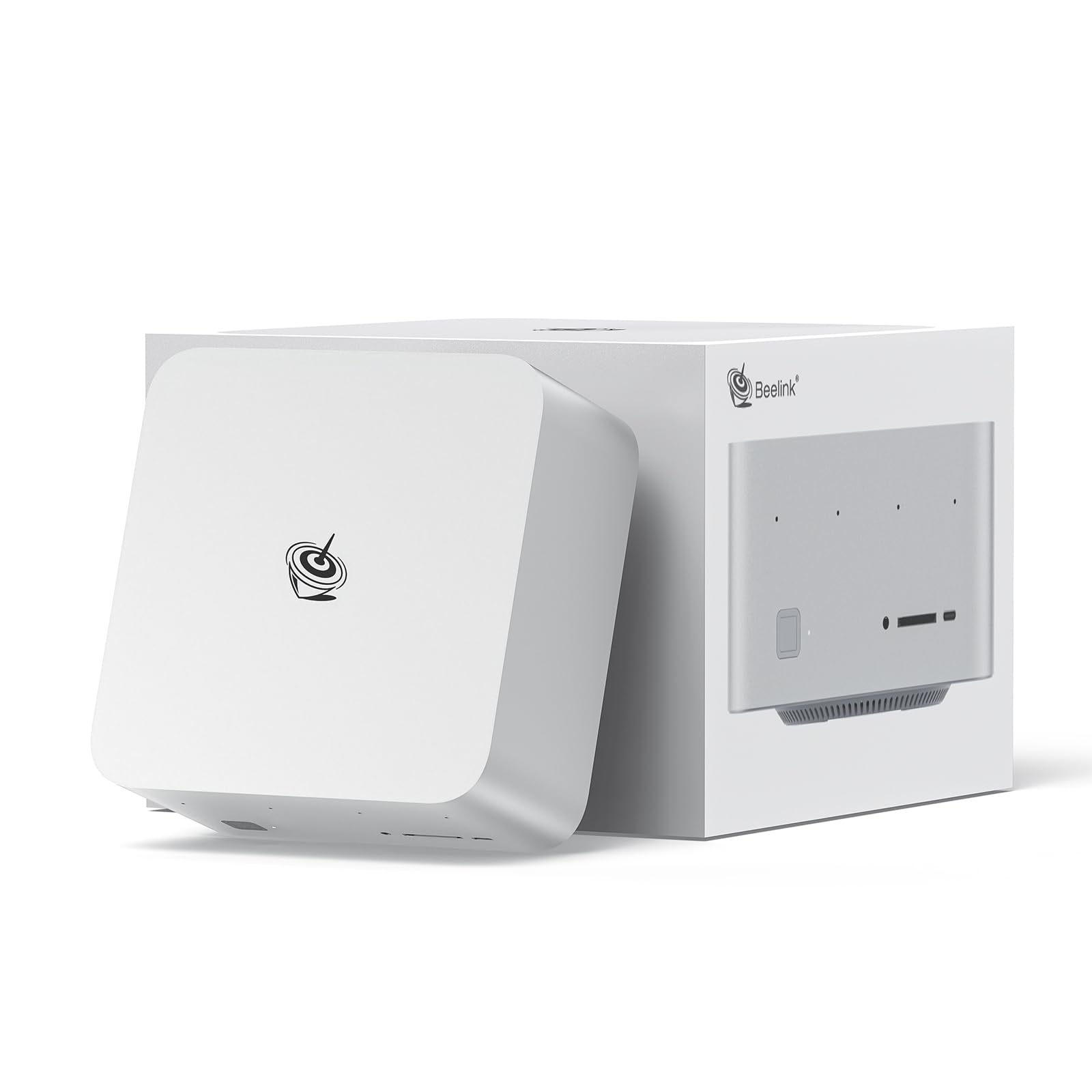
This Beelink desktop targets home labs and small teams that want 70B-class local inference in a compact chassis without assembling
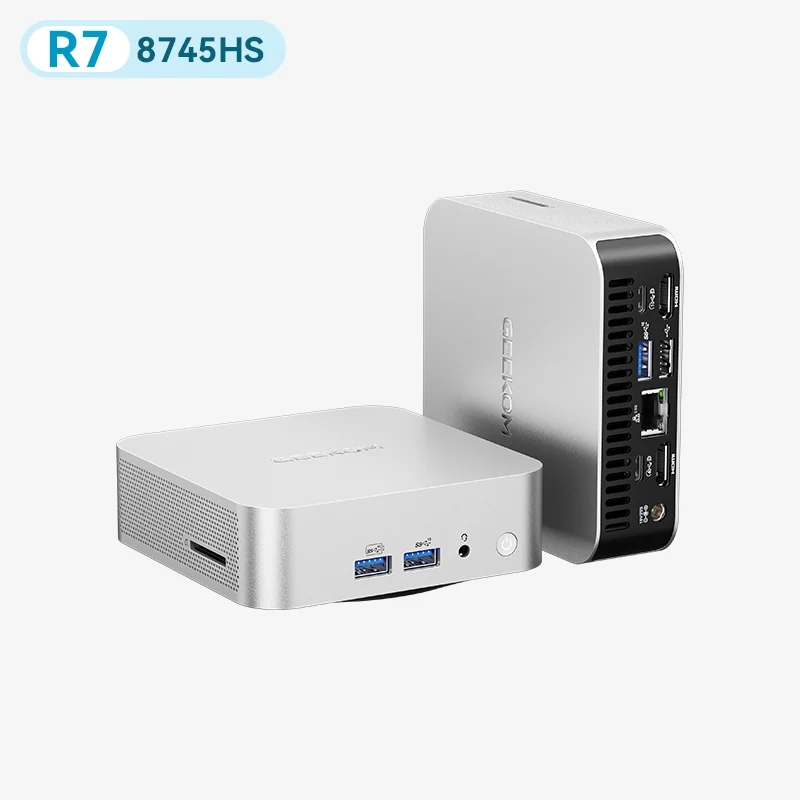
This GEEKOM mini PC is positioned as a general workstation for people whose day involves code builds, design files, 4K exports, an